Tuesday, May 15, 2012

Maryland Sheep and Wool Roundup!

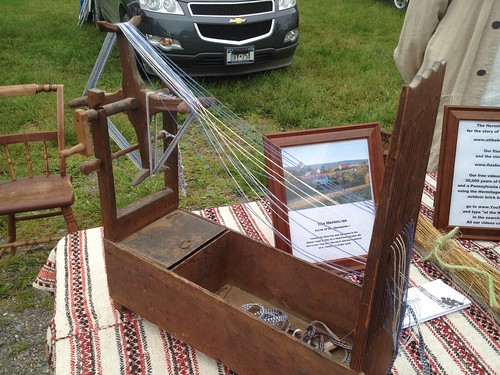
Maryland Sheep and Wool! It's awesome, as always. This year I went with Jenny Jo and another friend, Tracy. We bought things, we ate things, we watched things. One of the highlights for me this year was trying some new tools, in particular spinning wheels and accessories. I fell rather in love with the Pocket Wheel, and I was sorely tempted by the Woolee Winder, a spinning wheel accessory that winds the yarn evenly onto the bobbin, allowing you to spin without having to stop and adjust how the yarn is winding onto the bobbin. It means you can just spin, spin, spin, only having to stop to sip your adult beverage of choice. I was also very charmed by this antique loom that functions similarly to the inkle loom I was smitten by at Rhinebeck last year.
Untitled
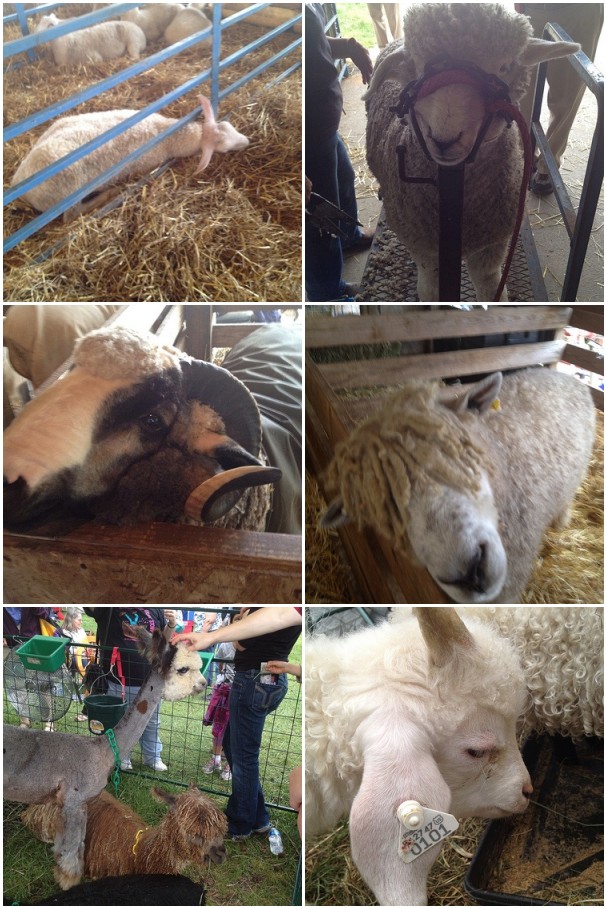
There are animals to pet, of course. I discovered I really love Karakul sheep.
mosaic2
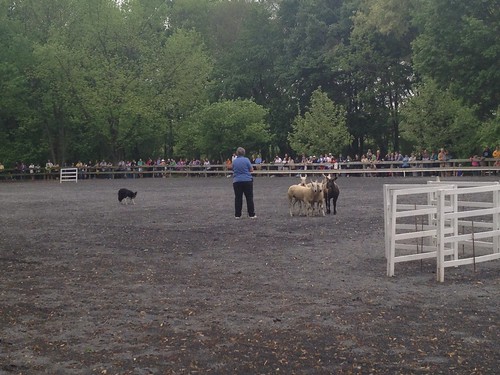
And sheepdogs.
Untitled
And tap dancing puppets. I love these.
Untitled
And shopping! Let's have a look-see at my haul.
mosaic1
There's two bullseye bumps from Loop, one from Spinabit (the camera can't capture the electricity of the blue, but I assure you, it's there, the stuff unicorn dreams are made of), a set of three from Hobbledehoy, a skein of yarn from Marigold Jen, and one from Miss Babs. If that last skein seems a little out of my color story, which may best be classified as "loud," it's because that skein is for husband socks, whose color story could best be classified as "light blue."
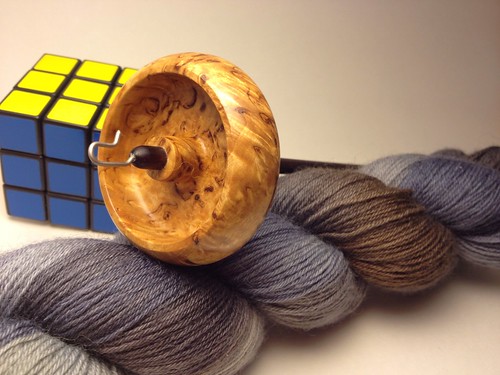
Plus I had to buy a spindle. The gorgeous spindle is made of Karelian birch and is a Bosworth. I love everything! I regret nothing!
Untitled
The other big huge new thing is that Jenny Jo and I picked out a fleece to split between the two of us. This is the first time either of us have taken such a big step in our spinning careers. I honestly have no intention of doing any of the processing of my half, and will happily ship it off so someone else can do the dirty work. It's a naturally colored merino fleece in an amazing gray from a sheep named Emma. Depending on what the finished fiber yield is from my half of the 7.5 pounds, I hope to make enough yarn for a vest or sweater. So exciting!
Untitled

Sunday, April 15, 2012

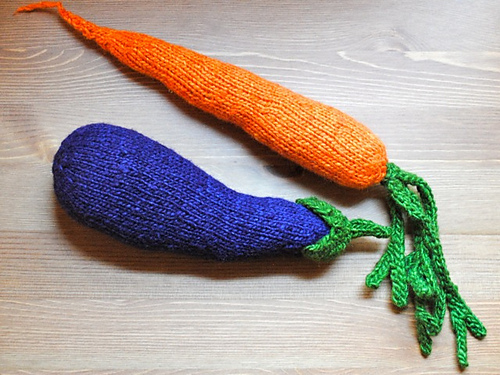
A knitted eggplant

I have never knit a stuffed animal.  I prefer stuffed vegetables -- and that's not a joke about how I'd rather be eating dinner than knitting, though admittedly, I probably would.


The latest round of veggies are for baby J -- they'll be a mobile until she's old enough to have a toy kitchen, at which point they'll turn into ingredients.  The idea is to convince her that vegetables are beautiful and awesome before she's old enough to have any reason to think otherwise!  I already have a carrot from my last round of vegetable knitting, and I just finished an eggplant.  I'm halfway through a beet, and considering rounding it off with a green pepper (peppers are hard).

There are plenty of patterns for veggies already out there, but I found them all too cartoony; they were symmetric and regular in a way that vegetables never are.  So, the first vegetables I knit came about after some very careful measuring:

This newer set of veggies are based on the notes I took that time, and a decent amount of making it up as I go along too.

In some ways, the knitting isn't hard.  Knitting tubes is easy; making tubes taper by judiciously decreasing is easy too, and then you can make them curve using short rows, and voila -- an eggplant (carrot, beet, potato, butternut squash, zuccini, etc) is born.  But on the other hand, this knitting is a bit of a pain in the ass -- whenever I put the project down, I need to make note of exactly where I am, because I can't "read" my previous knitting in the way you can with a more regular pattern.

But!  On the other other hand, these vegetables are impervious to small-to-medium sized mistakes. They're supposed to be organic-looking, meaning slightly irregular and asymmetrical, and every one is an individual.  Plus, you can easily knit one in an afternoon, so needing an attention span isn"t such a big deal.

Thus, I fittingly present you with, not a pattern, but a recipe for a knitted eggplant:

Ingredients:

  • Worsted or Aran weight yarn; about 45 yards of purple and 8 yards of green.  (use a different size yarn if you want to knit a different size eggplant, or are brave about resizing patterns.)
  • 1 yard of scrap yarn;
  • Size 3 or 4 needles (or whatever you need to get a very tightly knit fabric);
  • Fiber fill;
  • Yarn needle;
  • Safety pin or locking stitch marker;
  • Willingness to knit a simple lace pattern in the round without being told where the stitches should go on your needles.


Skills and abbreviations:

  • Cast on (CO);
  • Provisional cast on (PCO);
  • Bind off (BO);
  • Decrease stitch of your choice;
  • Decrease stitch that merges three stitches nicely (abbreviated dec 3->1; I accomplished this by slip, knit, pass slipped stitch over newly knit stitch, pass next stitch over newly knit stitch.) 
  • Short row shapping (including "wrap and turn" to make the edges nice);
  • Yarn over (YO);
  • I-cord.  


Before we begin, a word about shaping:  for the body of the eggplant, I am intentionally vague about placement of decreases, method of decreases, placement of short rows, and lengths of short rows.  This is intentional, and an essential part of this pattern!  I encourage you to be as random as possible in the placement of these elements; the result will be more organic-looking, and entirely individual.  Also, the numbers are approximate and should all be read with a +/- 20%, and I encourage you to be slightly sloppy in your counting.  Feel free, also, to add an extra short row somewhere along the way (or omit one of the ones called for).

Okay, onto the part that looks sort of like a pattern.

Knitting the body:

PCO 45 stitches in scrap yarn.
In purple yarn, knit 8 rows plain; place your safety pin/locking stitch marker at the beginning of one of the rows so that as the project progresses, you can remember where your rows begin.
Begin shaping the bottom half of the eggplant:

  • Decrease 1 stitch per row, for 4 rows;
  • Decrease 2 stitches per row, for 4 rows;
  • Decrease 3 stitches per row, for 3 rows;
  • Decrease 6 stitches per row, for 3 rows; 6 stitches remain.
  • Next cut your thread, leaving a 6 inch tail, and pull the tail through the remaining 6 stitches and tighten.  Sew in the end.  Do it now!  It will be a pain to do it later, once the eggplant is stuffed.


Next, remove the yarn of your PCO and slide the newly live stitches onto your needle(s).  With the purple yarn, begin shaping the top of the eggplant:


  • Over the next 4 rows, decrease 2 stitches total.  (Not 2 stitches each row; 2 stitches total.  I considered writing "decrease half a stitch per row for 4 rows", but decided that was even more confusing.
  • At some point in the next row, insert a short row of k stitches, for some 6<k<18.  (So, knit more than k stitches of that row, wrap and turn, purl k stitches, wrap and turn again.  In the next row, pick up the wraps from the wrapped stitches.  Consider rolling a pair of dice to select k.)
  • Over the next 8 rows, decrease 10 stitches total (not 10 each row, which is clearly impossible!).
  • In the next row, insert another short row of k stitches, for some 6<k<18.  Use a different value of k -- maybe roll the dice again!
  • Over the next 16 rows, decrease 8 stitches total.
  • In the next row, insert the final short row of k stitches, for some 6<k<12, using yet another value of k.
  • Over the next 8 rows, decrease 4 stitches total.  About 20 stitches remain.  Pause your knitting to mostly fill the body of the eggplant with fiber fill.
  • Decrease 2 stitches per row for 2 rows.
  • Decrease 4 stitches per row for 1 row. Add in a little more fiber fill.
  • Decrease 6 stitches per row for 1 row; about 6 stitches remain.
  • Cut your yarn, leaving a 6-inch tail, and thread it through these 6 stitches.  Add in a little more fiber fill, until the eggplant is pleasingly plump, and then pull the yarn tail tight.  Sew in the end.


Knitting the cap:

  • CO 36 stitches in green yarn.
  • First row: (k1, yo, k4, dec 3->1, k4, yo)x3.
  • Second row:  repeat first row.
  • Third row: (k5, dec 3->1, k4)x3
  • Fourth row: (k4, dec 3->1, k3)x3
  • Fifth row: (k3, dec 3->1, k2)x3
  • Sixth row: (k2, dec 3->1, k1)x3
  • Seventh row: (k1, dec 3->1)x3.  6 stitches remain.
  • move all stitches to one needle.  Knit an inch of i-cord, while decreasing down to 3 stitches.  bind off, cut a 9-inch tail, and thread this back through the i-cord tube.  

Now you'll use the tail of the green yarn to attach the cap to the body.  I suggest first threading it through the 6 stitches at the top of the body, then sewing down the three corners of the cap (pass the yarn through the inside of the eggplant to connect the different corners, so your hat will be firmly attached.)

Enjoy your eggplant!  And, perhaps, make yourself a delicious eggplant ragout as an award for a job well done.


Friday, March 30, 2012

Support your local...

Whenever I go on a road trip, I have this fantasy that I will happen upon a wonderful farm-stand by the side of the road, but instead of vegetables, they will be selling yarn and fiber. It hasn't happened yet, but the dream is one step closer to reality, thanks to this awesome website I just found:

http://www.localharvest.org/

This website is a directory of local farms all over the U.S. True, this is mostly about vegetables (have you signed up for your 2012 CSA yet?), but you can also search by product, including...ta-daa! Fiber! You can also look specifically for wool, angora, etc. You can even join a Wool CSA through the website! I mean--OMG! Isn't that completely fantastic?!? I love the internet more every day.

*Disclaimer: sadly, this is not actually a picture of a road-side wool stand, it's just what I imagine they would look like.

Wednesday, March 28, 2012

Thankful for the weather

Last week, temperatures in New York were in the mid 70s. I was of two minds about this. For one, it was great to sit outside and enjoy the blooming magnolias and other flowering trees on my lunch break.
photo
On the other hand, I mourned that we never had real winter in the city, and I never got to wear my winter boots or trudge through Fort Tryon park in the snow on my way to the Cloisters, my favorite snowy day activity.

Moreover, I was worried that I had missed the window to finish the crochet blanket I started in January. It's really warm, and to weave in all the ends, I was pretty much going to have to sit with it on my lap. I overheat really, really easily. Was I doomed?

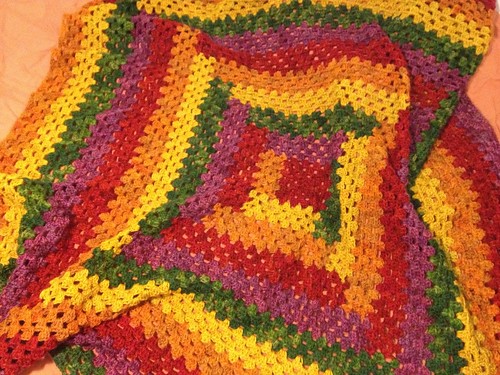
Then the weather turned! This week has been legitimately chilly, so here's my finished afghan.


I love quilts, but I'm intimidated by quilting, plus I don't have a sewing machine, so I like crocheting quilt patterns. I have actually done some quilting though, back in the day when I took the school bus out to the Leerkes' farm once a week to get sewing lessons from Mrs. Leerkes. She taught me that the center square of a log cabin quilt must be red, to represent the hearth of the cabin, so I kept the tradition in this afghan. I'm really happy with this aghan, so now I am in the preplanning stages of crocheting another quilt based on the Drunkard's path quilt pattern.

It was actually cold enough to snuggle under this blanket last night.


This pattern is Granny's Baby Log Cabin Blanket. The yarn is a mix of Decadent Fibers Cookie Dough and Creme Brulee yarns, purchased at Rhinebeck 2010. Now I'll probably get to use it for the rest of the week, and then put it away until next winter...

Monday, March 19, 2012

Fiber to Finished Object

There's a thread on Ravelry I first learned about from Jenny Jo that's a gallery of photos of unspun fiber, the finished yarn, and then the object knit from said yarn. It's a glorious thing to behold, full of surprises and sublime levels of talent. I was so excited about my February yarn that I knit it right away, so now I have the sequence of photos to contribute to the thread.

Fiber (Fiber Optic merino/silk in Copper to Verdigris):
photo

Yarn:
photo

Finished Object (Stephen West's Boneyard Shawl):
photo

I have lots more photos on my Ravelry project page, if anyone wants to check it out. I wish my photographic skills gave a consistent representation of the color of this project, but alas, those are not skills I have.

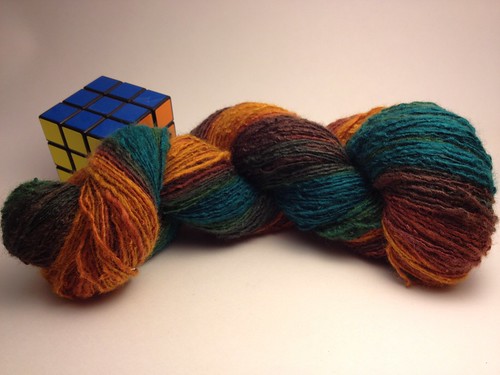
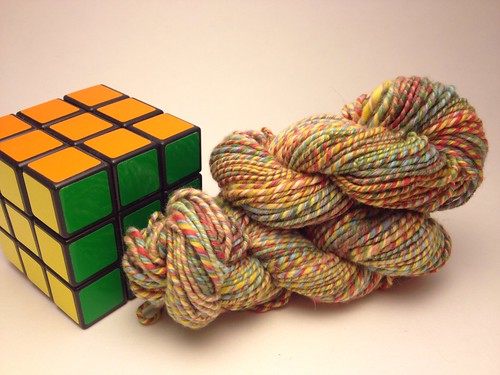
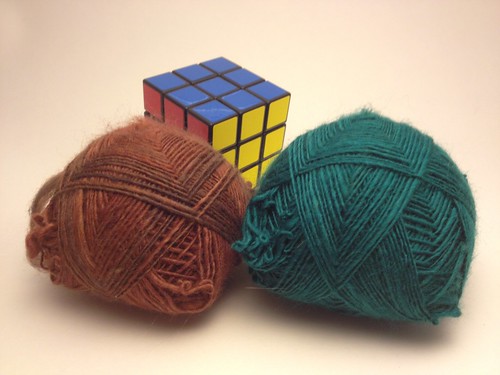
The Yarn Harlot's been on a spinning kick lately, and she said something that resonated with my thoughts on spinning at the moment, namely that she thought when she started spinning that she'd spin most of the yarn she used. That's not how I felt starting out, but it's totally how I feel these days. With the exception of things like blanketsworth of yarn (stay tuned, because I have a blanket FO to show you as soon as I weave in the ends and take photos), and probably some sock yarn, I think I would be really happy spinning for all my knitting/crocheting. Just look at these other two yarns I've finished this month! I feel like I have to put them to the top of the priority list because I'm in love with them both. I don't know that I'm feeling quite ready to destash all my commercially spun yarn and start from scratch, but I can say it's a tempting idea.

photo

photo

Friday, February 17, 2012

The February Surprise

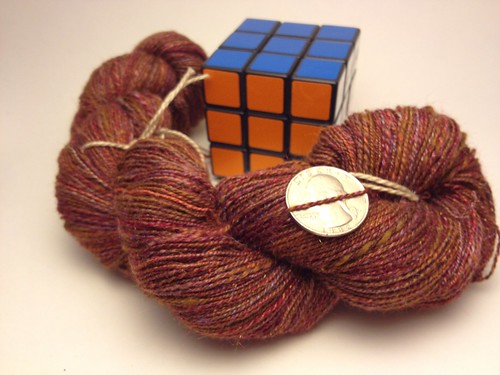
I will post about some knitting or crocheting at some point, but right now, I'm super into what I've been spinning. January was a great month for me. Three skeins!

Yarn the first. This was spun from a batt I received for my birthday that I felt compelled to spin in December even though December was for finishing up outstanding projects:
photo

Yarn the second. This was once ounce of C type pygora (that's the most cashmere-like grade), plied with silk. I'm in utter love with this one:
photo

Yarn the third. The January self-imposed spinning club project itself, in batt form:
photo

In cop form:
photo

And as yarn:
photo

On to February! The old random number generator gave me this project to spin:

photo

That's some merino silk from Fiber Optic, and a Jenkins lark. For some reason I have a bit of a hard time spinning silk blends consistently, so I figured I wouldn't be that concerned about it and try to spin a beefy single to keep the color gradient intact. Here are my beefy turtles:
photo
What was so great was that I knew a gradient was underneath. It was like an easter egg, or as one person on Ravelry likened it, an everlasting gobstopper. It's an apt comparison when it comes to the neverending task of winding yarn onto a niddy noddy. To paraphrase Gene Wilder, "You can wind it and wind it and wind, and it'll never get any smaller. At least I don't think they do."

Because I wanted the singles to be hale and hearty, I decided to give them a good fulling. Alternating hot and cold soapy water, agitation, a cathartic amount of whacking. So here's the surprise. I have a theory why the yarn turned out like this: I tend to overspin my singles, plus wool and silk don't behave the same when fulled. So, voila, my unusually textured finished yarn:
photo

I'm into it! Who knows if I could have made this on purpose? It's one of the great things about spinning, really more of an art than I science the way I practice it.

Wednesday, February 8, 2012

Spun to finished: BFL Thorpes

Unlike my co-blogger, Malia, I do not have a self-imposed spinning club. But I do have projects!

The interesting thing about this project was that I loved the fiber, but I couldn't get excited about the yarn...the texture was nice, but I wasn't into the colors. The ugly yarn sat around for months, un-loved, until finally I decided to just get it over with and make something (also I needed a hat). Lo and behold, the colors that looked so muddled in the skein sorted themselves out again into very attractive stripes, and I ended up with a hat that I really love.

Here's the fiber: Abstract Fiber BFL. Funny story, I was on a multi-stop trip and bought spinning fiber both in Northampton, MA (at Webs, of course), and in Oakland, CA (at Piedmont Yarn), and by pure accident I bought Abstract Fiber BFL in both places. What can I say? I love the colors!

I spun it into a basic 3-ply. Behold! Color mixing!

This is about the point where I lost interest in the yarn. The overall color effect of the skeins is just brown, and at close range you can see the dreadful clashing of sage-green, orange, and red-violet. Some people might be into this yarn, but I was very dubious.

When I finally did knit it up, the colors settled down quite a bit, into nice fuzzy stripes. I like it!
The pattern is Thorpe, by Kirsten kapur. I kept the larger hat for myself and donated the smaller one to a handknits drive at my local library. The green edging is a millspun yarn.